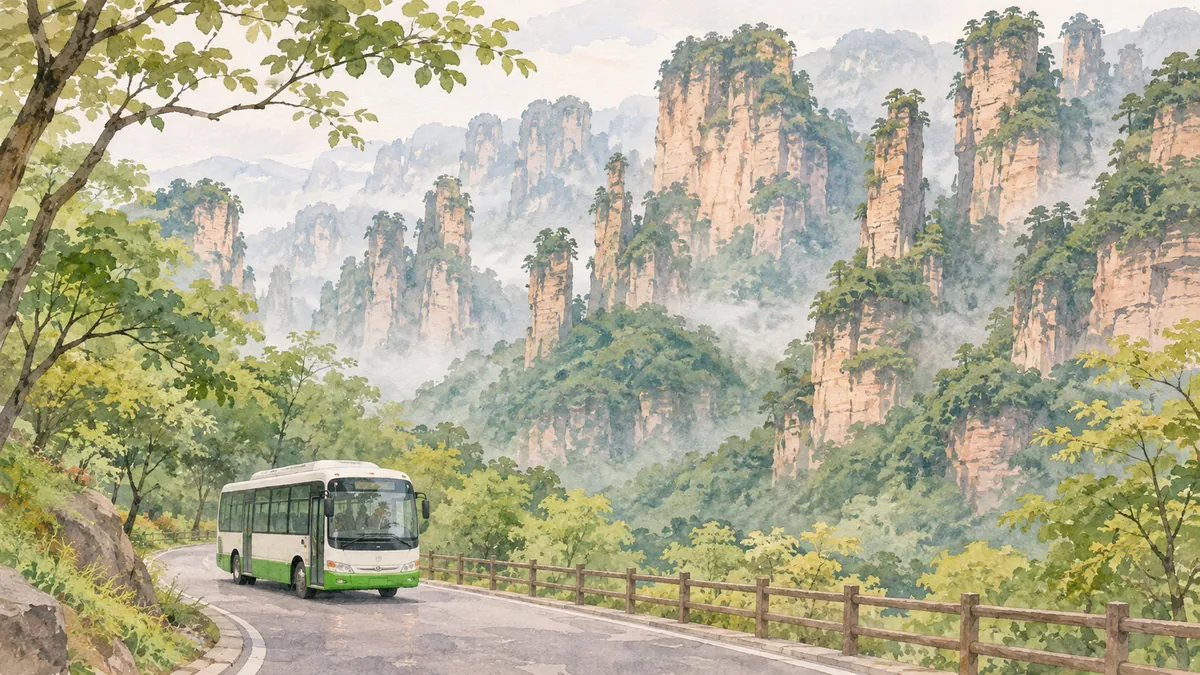
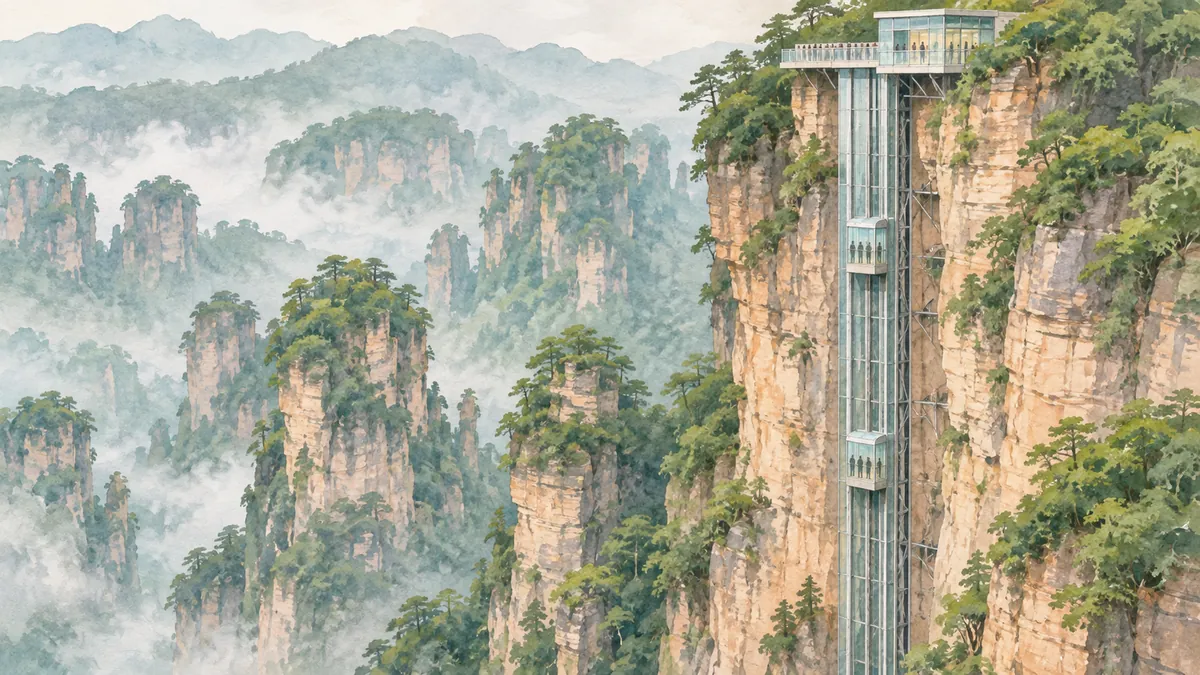
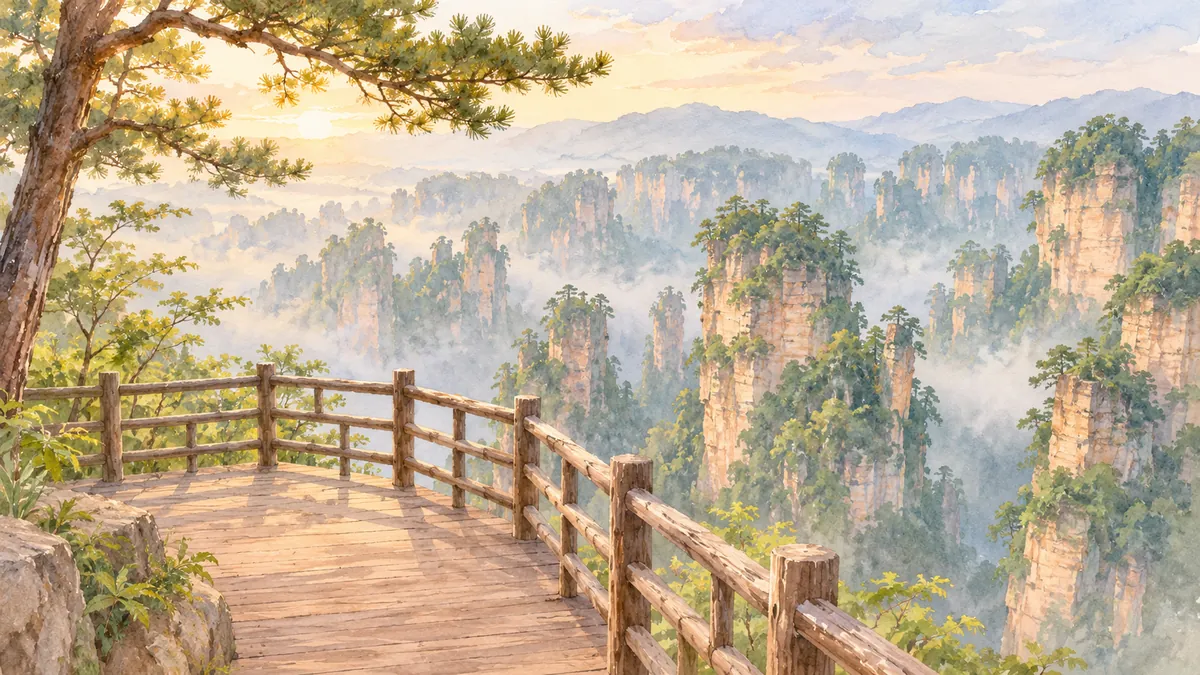
The best time to visit the Avatar Mountains is mid-September to early November, keeping clear of Golden Week on 1–7 October. September has the fewest rain days of the year in Zhangjiajie, 9.1 on the China Meteorological Administration’s 1991–2020 normals, and city highs fall from about 29 °C to 18 °C across the season. The second-best window is April to mid-May, away from Qingming and the 1–5 May Labour Day holiday. No month can guarantee clear views of the pillars, so whatever you pick, plan a spare day for fog.
Avatar Mountains day tour, tickets included
The Avatar Mountains Month by Month
The temperatures below come from the Zhangjiajie city weather station at 219 m. The viewing plateaus of Yuanjiajie and Tianzi Mountain sit around 1,050 to 1,260 m, and on the standard lapse rate they run roughly 6 °C cooler than the city. That is an estimate, because no weather station on the plateaus publishes normals, so pack a layer the city forecast doesn’t suggest.
Average highs and lows in Zhangjiajie city (219 m). The viewing plateaus sit around 1,050 to 1,260 m and run roughly 6 °C cooler, an estimate. Sunrise and sunset are for the 15th of the month.
Jan
9.5° / 2.9°C
11 rain days, 5 of them with snow. Plateau highs about 3–4 °C and frosty nights; ice can close stair sections. New Year 1–3 Jan.
Feb
12.2° / 4.9°C
11 rain days. Spring Festival 5–13 Feb 2027 (Seollal around 5–8 Feb) fills the park; avoid that week.
Mar
17.0° / 8.5°C
14 rain days and mild weather. No national holidays, so a quiet month.
Apr
23.4° / 13.8°C
14 rain days, fresh green cliffs and a chance of a sea of clouds after rain. Qingming 3–5 Apr 2027 is busy.
May
27.4° / 18.2°C
16 rain days, the most of the year. Labour Day 1–5 May brings long lift queues. Plum-rain fog season begins.
Jun
30.5° / 21.9°C
15 rain days and 220 mm of rain. Plum-rain fog can hide the pillars for days; stone steps get slippery.
Jul
33.5° / 24.4°C
The wettest month (227 mm) and hot in the valleys. Chinese school holidays begin; book entry slots ahead.
Aug
33.6° / 24.2°C
11 rain days, the hottest month in the city, afternoon storms and peak family crowds.
Sep
29.4° / 20.4°C
9 rain days, the fewest of the year. Mid-Autumn 15 Sep and Chuseok 14–16 Sep 2027 bring a busy few days.
Oct
23.3° / 15.1°C
13 rain days and mild. Golden Week 1–7 Oct sold out the park in 2025; from 8 Oct the crowds fall away.
Nov
17.9° / 9.7°C
10 rain days; a sea of clouds can form after rain. No holidays. Short afternoons.
Dec
12.2° / 4.9°C
The driest month (27 mm) and the quietest. Cold on the plateau, and you need to be heading down by mid-afternoon.
Sources: Temperatures and rain days: China Meteorological Administration 1991–2020 normals for the Zhangjiajie city station, via the CMA climate table reproduced on Wikipedia; plateau figures are an estimate (about 0.6 °C cooler per 100 m). Sunrise and sunset: calculated for Wulingyuan on the 15th. Holidays: State Council of China notices for 2026 and 2027; Korean holidays from publicholidays.co.kr. Golden Week sell-out: voc.com.cn, October 2025. Read November 2026.
Nobody publishes monthly visitor numbers for the park, so the crowd notes in each month come from the public holiday dates and from reports of the park selling out.
Mid-September to Early November: the Best Window
This is the season to aim for if your dates are free. September averages 9.1 rain days in the city, the fewest of any month, with highs of 29.4 °C and lows of 20.4 °C. On the plateau that comes out at about 23 °C by day, comfortable for the stairs. October brings 12.6 rain days and highs of 23.3 °C, and November 10.4 rain days and 17.9 °C. By November you need a warm layer on top, where the estimate puts the afternoon at about 12 °C.
Two stretches inside this window are best avoided:
- Golden Week, 1–7 October, in both 2026 and 2027. In 2025 Forest Park reservations hit their cap during the week and same-day bookings stopped. Bailong Elevator queues run to three hours and more on big holidays.
- Mid-September around the Mid-Autumn Festival. In 2027 it falls on 15 September, and Korea’s Chuseok holiday runs 14–16 September. Korea is the park’s largest overseas market, so expect a busy few days.
From 8 October to early November the holidays are over, the summer heat has gone and days are still long enough for a full loop of the plateau. If you can choose a single fortnight, choose late October.
Spring: April to Mid-May
Spring is the second-best season. April averages 14.4 rain days and highs of 23.4 °C in the city, and the cliffs turn green. A sea of clouds, when the pillars stand above a layer of low cloud, is reported after rain in spring and again in late autumn. You need rain the day before and a clearing morning, so it comes and goes with the weather, not the calendar.
Three holidays fall in spring. Qingming runs 3–5 April in 2027 (4–6 April in 2026), and Labour Day 1–5 May in both years. Avoid both. May then turns wet: it has the most rain days of the year, 16.3, and the plum-rain season brings the first long spells of fog late in the month. Visit before mid-May if spring is your only option.
Fog, Cloud and the Sea of Clouds
Fog is the biggest risk to your trip, more than heat or crowds. No official record of fog days in the park exists, and no month is fog-free. Some visitors have spent three days in Zhangjiajie without seeing a single pillar, most often during the May–June plum rains. Low cloud is also what makes the sandstone columns look as if they float, so a grey morning can turn into the view you came for.
How to plan around it:
- Give the park two days, or keep a spare day in Wulingyuan, so one foggy day doesn’t cost you the trip.
- At a fogged viewpoint, wait. Mist tends to clear in pulses, and ten minutes can be enough for the pillars to show.
- If the higher plateaus are lost in cloud, go to Huangshi Zhai (Yellow Stone Village) by cable car from the South Gate, or walk Golden Whip Stream on the valley floor, where you look up at the cliffs from below the cloud.
- Check the forecast the day before a tour. TravelChinaGuide, the operator of the 1-Day All-Inclusive Tour to Forest Park, Avatar and Bailong Elevator, says weather is not grounds for a refund, so use the free cancellation, which ends 24 hours before the start.
No tour can guarantee clear views. Reviewers often praise guides who reroute the day for the weather, which is one reason the Avatar Mountains day tour suits a short trip in an uncertain month.
Summer Heat, Rain and School Holidays
Summer is the hardest season for the Avatar Mountains. June and July are the wettest months, with 219.8 mm and 226.9 mm of rain in the city, and stone steps on the plateau trails get slippery in the wet. July and August highs reach 33.5 °C in the city, about 27 °C on the plateau by the lapse-rate estimate, and August brings afternoon storms.
Crowds peak at the same time. Chinese school holidays usually run through July and August, although each province sets its own dates. Entry slots can sell out in summer, so book the park 1–3 days ahead. On busy days the Tianzi Mountain cable car queue reaches two hours; it usually drops under 15 minutes after 16:00.
Summer does give you the longest days, with sunset around 19:38 in mid-June. If you go in July or August, take the first entry slot of the day and pack a rain jacket. Bring plenty of water as well.
Visiting the Avatar Mountains in Winter
Winter is the quietest time to visit. December is the driest month, with 26.9 mm of rain and 8.6 rain days, and daily visitor numbers are reported to fall to about 3,000–6,000. The cost is cold and short days. January highs are 9.5 °C in the city, which puts the plateau at about 3–4 °C by day with lows below freezing. The city station records five snow days in an average January, and rime ice can form on the trees on cold mornings.
Ice brings closures. Stair sections can close when they ice over, and you should check the park’s notices on the morning you go. Winter is also no cheaper: the park now charges the same price all year, and the old off-season discount has gone.
Light is the other limit. From November to January, sunset falls around 17:40 to 18:00, close to the 17:00 last entry. Cable cars stop about an hour and a half before the park closes, and the last plateau eco-buses leave about an hour earlier than in summer. Start heading down by mid-afternoon.
Chinese and Korean Holidays in 2026 and 2027
Holidays matter more than weather for queues at the Bailong Elevator and the eco-bus stops. These are the State Council dates for China, and the Korean holidays that bring the largest group of foreign visitors.
| Holiday | 2026 | 2027 |
|---|---|---|
| New Year | 1–3 January | 1–3 January |
| Spring Festival (Chinese New Year) | 15–23 February | 5–13 February |
| Seollal (Korean Lunar New Year) | 16–18 February | around 5–8 February |
| Qingming | 4–6 April | 3–5 April |
| Labour Day | 1–5 May | 1–5 May |
| Dragon Boat Festival | 19–21 June | 9 June |
| Mid-Autumn Festival | 25–27 September | 15 September |
| Chuseok (Korea) | 24–26 September | 14–16 September |
| National Day (Golden Week) | 1–7 October | 1–7 October |
Spring Festival, Labour Day and Golden Week are the three to avoid. Bailong queues run 3–5 hours at Chinese New Year and on 1 October, against about 1–1.5 hours on a normal morning. Some ticket resellers stop selling on these dates: the Zhangjiajie National Park Entry Ticket & Bailong Elevator pass is not sold for the first seven days of Chinese New Year, 1–5 May or 1–7 October.
If you have to travel in a holiday week, book the entry slot as early as it opens and arrive for the first slot of the day. A paid Bailong priority lane returned in October 2026 at ¥100 per person per ride, booked in advance.
Opening Hours, the Last Eco-Bus and Daylight
The park’s gates open around 07:00 to 07:30 and the last entry is at 17:00 all year. In National Day week the gates open at 06:30. Each entry needs its own real-name booking for a time slot at a named gate, so choose your slot when you book.
The end of the day decides how much you see. The last eco-buses leave the plateau loops around 17:30 to 17:40 and the valley lines around 18:00 (up to 18:30 in peak season), and about an hour earlier off-season. The park sets the times each day by crowd levels. Be heading down by 16:30 to 17:00, and by mid-afternoon in winter. The Bailong Elevator keeps running until everyone is down, so the eco-bus is the one to watch.
Sunrise ranges from about 05:38 in mid-June to 07:33 in mid-January, and sunset from 17:42 in December to 19:39 in July. For most of the year the sun is up before the gates open. To beat the crowds, take the reverse route: up by the Tianzi Mountain cable car in the morning, down by the Bailong Elevator in the afternoon. Our guide to visiting the Avatar Mountains has the full route and the buses to the gates.
Which Weeks to Book
Book for the second half of October if you can, or the second half of September outside Mid-Autumn and Chuseok. Late April and early May, before 1 May, come next. Avoid Golden Week, Labour Day and Spring Festival, and keep June and July for trips you can’t move.
Whatever the month, give the park two days or keep one in hand, sleep in Wulingyuan near the East Gate, and check the forecast before your free-cancellation deadline. Compare the day and two-day options in our guide to the best Avatar Mountains tours, or see what each park ticket and lift costs in the tickets guide.
Frequently Asked Questions
What is the best time to visit the Avatar Mountains?
Mid-September to early November, avoiding Golden Week on 1–7 October. September has the fewest rain days of the year (9.1 on the 1991–2020 normals for Zhangjiajie city) and October and early November are mild. April to mid-May is the second-best window, away from Qingming and 1–5 May.
Can you see the mountains in fog or rain?
Sometimes, and no tour can guarantee it. Mist often clears in pulses, so waiting ten minutes at a viewpoint can help. When the plateaus are hidden, head for Huangshi Zhai or walk Golden Whip Stream on the valley floor, and keep a spare day in your plan.
Can you visit in winter?
Yes. December and January are the quietest and driest months, but the plateau is near freezing, stair sections can close for ice, and sunset comes around 17:40 to 18:00. Start heading down by mid-afternoon. The park charges the same price all year, so winter is no cheaper.
What is the worst time to visit Zhangjiajie National Forest Park?
Golden Week (1–7 October), Labour Day (1–5 May) and Spring Festival (5–13 February in 2027) for crowds, when reservations can sell out and Bailong queues run 3–5 hours. May to July for rain and fog, and July and August for heat with school-holiday crowds.
How much colder is it on top of the mountains?
Roughly 6 °C colder than the city forecast, an estimate from the standard lapse rate, since the plateaus have no published weather normals. In January that means highs of about 3–4 °C and frost at night.
Is the park cheaper in the off-season?
No. The four-day park pass costs about ¥236–240 all year, and the old winter discount no longer applies. The lifts are extra in every season: ¥65 one way for the Bailong Elevator and ¥72 for the Tianzi Mountain cable car.
Check Dates for the Avatar Mountains Day Tour
Park tickets, the Bailong Elevator and the Tianzi Mountain cable car are in the price, and free cancellation up to 24 hours before lets you move the day if the forecast turns.
Check dates & prices